
What Rapid Weight Loss Juicing Recipes and Vegan Juice Cleanses Actually Do to Your Body


The appeal of juicing for weight loss is easy to understand. It is plant-based, it looks clean and vibrant, and the before-and-after results people post online are real. Something is clearly happening. The question worth asking is what, exactly, is happening inside the body during a juice cleanse, whether it is what the results make it appear to be, and whether the same outcome is achievable through an approach that does not come with a metabolic cost most people are never warned about.
There is a meaningful difference between vegan juice recipes as a nutritional tool and juicing as a primary weight loss strategy. The first is genuinely useful and well-supported by the evidence on plant-based nutrition. The second creates a set of physiological effects that most cleanse programs and recipe blogs do not discuss, because the part of the story that makes the short-term results look impressive is also the part that explains why those results rarely last.
What Actually Happens to Your Body During a Juice Cleanse
Most rapid weight loss juicing programs run on 800 to 1,200 calories per day, delivered entirely in liquid form with no solid protein and very little fat. That is a significant calorie deficit, and the body responds to it in a sequence that is well-documented and fairly predictable, even if it is rarely described honestly in the places people find these recipes.
Days one and two produce the most dramatic scale movement, typically two to four pounds. Almost none of this is fat. The body stores carbohydrates as glycogen in the muscles and liver, and each gram of stored glycogen holds roughly three grams of water alongside it. When carbohydrate intake drops sharply, glycogen depletes quickly and the water attached to it leaves with it. The number on the scale moves significantly. The body fat number barely moves at all.
By days three and four, glycogen stores are largely exhausted. The body now needs to find another source of energy. In the absence of dietary protein, it increasingly turns to muscle tissue, breaking down amino acids to produce glucose for the brain and organs that require it. This is not a small or theoretical concern. Research on very low-calorie liquid diets consistently shows measurable loss of lean muscle mass within the first week, even in shorter cleanses. Muscle tissue is metabolically expensive, which is precisely why the body targets it under conditions of severe restriction.
By days five through seven, the metabolism has begun downregulating to compensate for the reduced energy intake. This is called adaptive thermogenesis, and it means the body is now burning fewer calories at rest than it was before the cleanse began. The deficit that produced the initial results is now smaller because the body has adjusted its energy expenditure downward to protect itself.
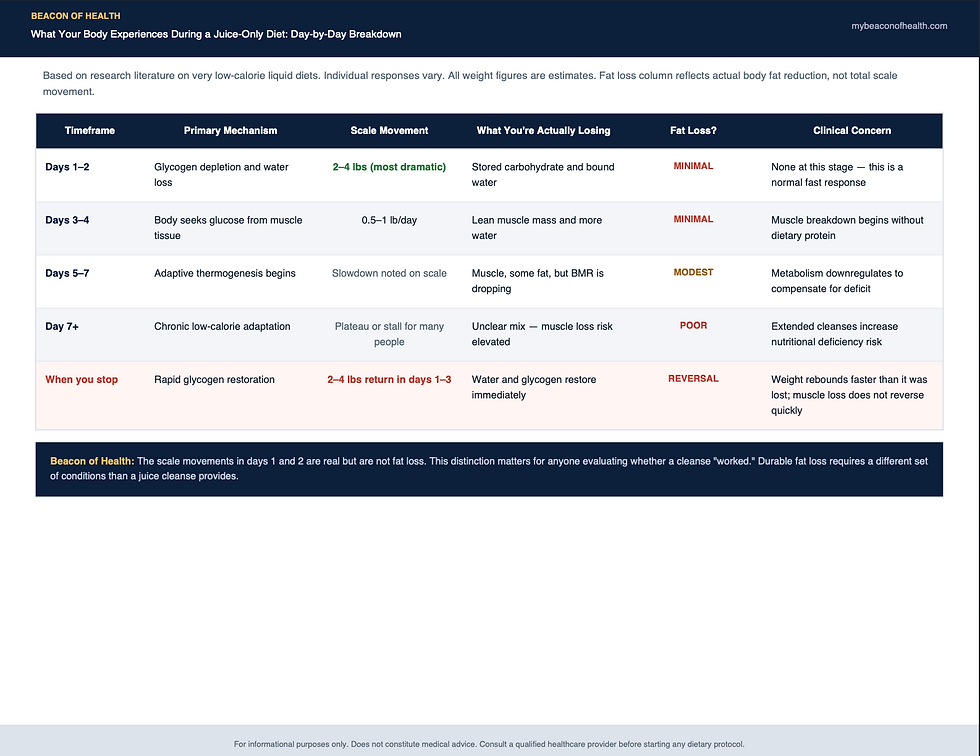
THE WEIGHT THAT COMES BACK When a juice cleanse ends and normal eating resumes, the body rapidly restores glycogen stores and the water weight that came with them. The four pounds lost in days one and two returns in the first day or two of regular eating. The muscle tissue lost does not return as quickly. And because lean muscle mass is one of the primary drivers of resting metabolic rate, losing it means the body now burns fewer calories at rest than it did before the cleanse, making subsequent weight loss harder than it was before.
What Happens to Fiber in Vegan Juice Recipes (And Why It Matters)
One of the most significant and least discussed downsides of juicing, even with genuinely healthy vegan juice recipes, is what gets left behind in the juicer. Fiber is removed almost entirely in the juicing process. The pulp that gets discarded contains the dietary fiber that would otherwise slow digestion, feed the gut microbiome, stabilize blood sugar responses, and create the sustained sense of fullness that helps regulate appetite throughout the day.
This matters in several ways. First, without fiber, the natural sugars in fruit and vegetable juices are absorbed much more rapidly than they would be from whole produce. A glass of carrot, apple, and beet juice may contain 30 or more grams of sugar with minimal fiber to blunt the blood sugar response. For someone with insulin resistance or prediabetes, this is clinically significant. The juice that looks like a health-forward choice is delivering a glycemic response closer to a sugary drink than to a plate of vegetables.
Second, the gut microbiome depends on dietary fiber for the fermentation process that produces short-chain fatty acids, supports immune function, regulates inflammation, and influences mood through the gut-brain axis. A week of very low fiber intake disrupts the microbiome measurably. The research on this is fairly consistent: fiber-rich diets support metabolic health and weight management, and removing fiber from otherwise nutritious produce does not improve the metabolic outcome.
The straightforward comparison here is between juicing and blending. A smoothie made from the same vegan juice recipe ingredients retains all of the fiber because nothing is discarded. The calorie count is similar. The satiety, the blood sugar response, and the gut health implications are meaningfully better. For people who enjoy the routine of morning green drinks for weight loss and health, blending is the more nutritionally complete approach.
Vegan juice recipes made from leafy greens, cucumber, ginger, and lemon are genuinely nutritious. The problem is not the ingredients. It is removing the fiber from them and using the result as the primary source of nutrition for days at a time, which creates a set of metabolic effects that the produce itself, eaten whole, would not produce.
Popular Vegan Juice Recipes: What They Contain and What Gets Left Behind
The recipes themselves are worth examining directly, because the ingredients in most popular vegan juice recipes for weight loss are genuinely good ones. The issue is entirely in how they are processed and in what role they are being asked to play in someone's diet. The table below breaks down five of the most commonly searched rapid weight loss juicing recipes, showing the nutrition as a juice and as a whole-food equivalent.

The pattern visible across all five recipes is consistent: the ingredients are nutritious, the calorie counts are reasonable, but the fiber removal is significant across the board. In recipes that include beet or apple, the sugar content without fiber to moderate its absorption is also worth noting for anyone managing blood sugar. None of this makes these recipes harmful as occasional additions to a balanced diet. It does make them poor candidates for a multi-day exclusive cleanse.
When Juicing Actually Makes Sense
The case against juicing as a primary weight loss strategy is not a case against juicing entirely. There are genuinely useful contexts for incorporating vegan juice recipes into a healthy diet.
As a supplement to whole food intake rather than a replacement for it, a daily green juice made from leafy greens, cucumber, celery, and lemon adds meaningful micronutrients without significantly disrupting calorie balance.
For people who struggle to eat enough vegetables, this is a practical and beneficial habit. The key distinction is between adding and replacing.
As a bridge during illness or gut recovery, when solid food tolerance is temporarily reduced, low-sugar vegetable juices can provide some nutrition without demanding full digestive capacity. In this context the short duration and the clinical context justify the tradeoffs.
As part of a medically supervised protocol, some practitioners use modified fasting approaches that incorporate juices alongside structured nutrition support. These protocols are designed to avoid the muscle loss and metabolic suppression of unguided cleanses by including protein and monitoring the physiological response. They are not the same as an at-home cleanse.
What juicing is not well-suited for is serving as the primary vehicle for rapid fat loss in an otherwise unrestricted approach to eating. The metabolic consequences of that use are the ones described throughout this article, and they consistently produce short-term results followed by rebound weight gain in the research literature on very low-calorie liquid diets.
A better-performing alternative: the smoothie swap
For people who enjoy the ritual of morning green drinks and the feeling of starting the day with a concentrated dose of plant nutrition, a straightforward adjustment produces meaningfully better outcomes. Blending rather than juicing retains the fiber. Adding a protein source, whether that is Greek yogurt, a plant-based protein powder, or nut butter, addresses the satiety gap and protects muscle tissue. The drink still looks and tastes like a healthy green smoothie. The metabolic effect on the body is substantially different from the juice equivalent because the components that were doing most of the beneficial work are still there.
A NOTE ON SUGAR IN "HEALTHY" JUICES A common misconception about vegan juice recipes for weight loss is that the sugar in fruit and vegetable juice is fundamentally different from added sugar in processed food. Fructose metabolizes through the same pathways regardless of its source. Without fiber to slow absorption, a glass of apple-beet-carrot juice delivers a glycemic response comparable to other high-sugar beverages. For people with insulin resistance, prediabetes, or type 2 diabetes, this distinction matters significantly, and these juices should be discussed with a provider before incorporating them regularly.
Why the Scale Moves but the Fat Does Not
The central confusion in rapid weight loss juicing is the difference between weight loss and fat loss. They are not the same thing, and most people treating them as equivalent are the same people who find that their cleanse results evaporate within a week of finishing.
Fat loss requires a sustained caloric deficit over a period of weeks that allows the body to mobilize stored fat as fuel. It requires preserving muscle mass through adequate protein intake, because muscle tissue is what drives the metabolic rate that makes the deficit meaningful over time. And it requires a metabolic environment that is capable of mobilizing fat efficiently, which for many people means addressing underlying conditions like insulin resistance, thyroid dysregulation, or hormonal imbalances that directly affect fat metabolism.
A juice cleanse achieves a rapid scale reduction through water loss and glycogen depletion. It does not create the conditions for efficient fat mobilization because protein is absent, fiber is absent, and the severe calorie restriction produces adaptive metabolic slowdown that works against the deficit rather than with it. The results are real in the short term and typically not durable, which is a pattern visible not just in individual experiences but in the research literature on liquid very low-calorie diets consistently across decades.
What Actually Produces Lasting Fat Loss
Lasting fat loss requires understanding the metabolic picture of the specific person trying to achieve it. For most people, that picture includes a combination of caloric balance, adequate protein to preserve muscle, dietary fiber for blood sugar stability and gut health, physical activity, quality sleep, and stress management. None of those requirements are served well by a juice cleanse, and the combination of muscle loss and metabolic downregulation that an aggressive cleanse produces can actually make subsequent fat loss harder than it was before.
For people who have tried multiple approaches to weight loss and found that the results are either not materializing or not lasting, the most productive step is a clinical assessment of what may be driving the difficulty. Insulin resistance, thyroid conditions, PCOS, cortisol dysregulation, and the metabolic effects of certain medications are all common contributors to weight loss resistance that no juice recipe was designed to address. These are clinical problems that respond to clinical intervention, not to a more disciplined cleanse.
Beacon of Health provides virtual medical weight loss support that starts with the actual metabolic picture of each patient. The goal is not another program to add to a list of things that have already been tried. It is an honest assessment of what is actually happening and a treatment plan that addresses it directly.
FROM THE BEACON OF HEALTH TEAM The clinical team at Beacon regularly works with patients who have arrived having tried cleanses, juice programs, and a range of popular rapid weight loss approaches before seeking medical guidance. What these patients have in common is genuine effort and legitimate frustration that the results did not hold. That frustration is understandable. It is also clinically informative. Weight that does not respond durably to these interventions is almost always pointing to something metabolic that the intervention was not designed to reach. Finding and addressing that something is the work that produces outcomes that last. That is the conversation Beacon is built for.
Have you completed multiple juice cleanses or rapid weight loss programs with results that did not last? That pattern is clinical information, not a reflection of your commitment or discipline. It may indicate a metabolic factor that is working against your efforts. A virtual consultation with Beacon of Health is a practical next step toward understanding what is actually happening and what would genuinely help.
Your Body Deserves Better Than a Cleanse Rapid weight loss juicing recipes can produce fast results. They rarely produce lasting ones. If you are ready to understand what your metabolism actually needs to lose weight and keep it off, Beacon of Health provides virtual medical weight loss support built around your real clinical picture.
Comments