
The Truth About Goli Gummies. Will it help you lose weight?
- Beacon Of Health
- May 27
- 7 min read

There is a reason Goli gummies are everywhere. They taste good, they are convenient, and they come backed by the credibility of apple cider vinegar — a folk remedy with a long history and some genuine science behind it. If you are wondering whether they actually help with weight loss, the honest answer is more nuanced than the five-star reviews suggest, and more useful than a simple yes or no.
This is not an article that will tell you Goli gummies are a scam or that you wasted your money. The ingredients are not harmful. The apple cider vinegar inside them has real, documented biological effects. But there is a significant gap between what the marketing suggests and what the research can actually suppor, and understanding that gap is what makes the difference between spending money on hope and making decisions that actually change your metabolic picture.
What Is Actually in a Goli Gummy?
Each Goli gummy contains apple cider vinegar as its primary active ingredient, alongside B9 (folate), B12, beetroot juice, and pomegranate juice. The recommended dose is two gummies per serving, which delivers approximately 500 milligrams of apple cider vinegar equivalent. That number matters a great deal.
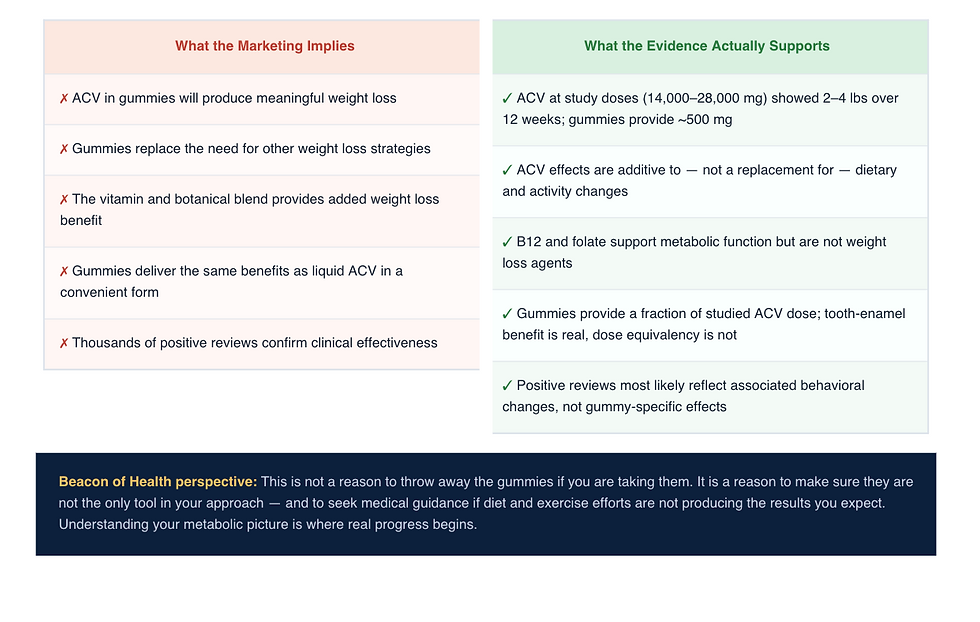
The most cited clinical studies on apple cider vinegar and weight loss used one to two tablespoons of liquid ACV daily, which is roughly 14,000 to 28,000 milligrams. Two Goli gummies deliver about 500 milligrams. To match what the study participants consumed, you would need to take approximately 56 gummies per day. That is the ingredient gap that most of the marketing glosses over entirely.

What Does the Research on Apple Cider Vinegar Actually Show?
The apple cider vinegar research is real, and it deserves a fair reading. A widely cited 2009 Japanese study involving 155 participants found that taking one to two tablespoons of liquid ACV daily for twelve weeks produced an average weight loss of two to four pounds compared to a placebo group. Blood pressure and triglyceride levels also improved modestly. That is a legitimate finding. It is also two to four pounds over three months, in people drinking straight liquid ACV at doses far beyond what gummies provide.
More robust evidence exists for ACV's effect on post-meal blood sugar. Several studies have found that consuming vinegar with or before a carbohydrate-heavy meal blunts the blood glucose spike that follows. For people managing insulin resistance or prediabetes, this is genuinely clinically interesting. It is not weight loss per se, but blood sugar stabilization is a meaningful component of metabolic health management.
The honest summary: ACV has modest, real effects that are primarily relevant to blood sugar management rather than dramatic weight loss, and those effects have been studied at doses that gummies do not come close to delivering.
THE DOSE PROBLEM IN PLAIN TERMS If a study showed that drinking 8 glasses of water per day produced a health benefit, a product delivering 1/56th of a glass would not be expected to reproduce that benefit. That is the proportional gap between the ACV in two Goli gummies and the amount used in weight loss research. The ingredient is real. The dose is the issue.
Why the Five-Star Reviews Exist (And What They Are Really Measuring)
Goli gummies have genuinely positive reviews from people who say they helped with weight loss. This is not fabricated. But what is almost certainly happening in those cases is not the gummies doing the heavy lifting. When someone starts taking a supplement with the intention of losing weight, they typically also make other changes at the same time, paying more attention to what they eat, drinking more water, moving a little more, becoming generally more mindful of their health choices. The supplement becomes the anchor behavior around which other changes cluster, and the weight loss that follows gets attributed to the gummies rather than to the constellation of behavioral changes they prompted.
This is not a criticism of the people reporting those results. It is a well-documented pattern in behavioral health research called the "sentinel behavior" effect, and it applies to everything from apple cider vinegar to morning journaling. The gummies did not lose the weight. The person's increased health intentionality did. The gummies were the symbol of that intention.
The question is not whether Goli gummies hurt you. They do not. The question is whether they are the best use of the energy and money of someone who genuinely wants to change their metabolic health. For most people, the answer is that the same intention directed toward evidence-based support would go further.
Marketing vs. Reality: What Goli's Claims Actually Mean
The comparison below is not meant to be harsh — it is meant to be clarifying. Goli is a well-made product with a legitimate ingredient list. The problem is the gap between what the marketing implies and what the clinical evidence can actually support at the doses provided.
When Goli Gummies Actually Make Sense
There are genuine reasons someone might reasonably choose Goli gummies, and it is worth naming them honestly.
People who want the potential blood sugar benefits of ACV but cannot tolerate straight liquid vinegar, which is harsh on tooth enamel and the esophagus when consumed undiluted, get a real advantage from the gummy format, even if the dose is lower than study amounts. The gummies are also a legitimate and convenient B12 and folate source for vegetarians, vegans, and older adults who are often deficient in these nutrients and who may notice a meaningful improvement in energy and mood from correcting that deficiency. And if taking a gummy in the morning helps someone build a health-conscious morning routine that includes better choices throughout the day, that behavioral anchor has real value even if the gummy itself is not the mechanism.
None of those are reasons to expect the scale to move. But they are honest reasons the gummies may be worth continuing for some people.
What Actually Moves the Scale When Gummies Do Not
For people who have tried everything available over the counter and are frustrated by the gap between effort and results, the answer almost never lies in finding a better supplement. It lies in understanding what is actually happening metabolically for that specific person.
Insulin resistance is one of the most common and most commonly overlooked drivers of weight loss resistance. When cells do not respond normally to insulin, the body stores fat more readily and burns it more reluctantly, and no supplement addresses that. Hypothyroidism slows the metabolic rate in ways that make weight loss genuinely harder regardless of dietary compliance. Hormonal imbalances, including PCOS, perimenopause-related changes, and cortisol dysregulation from chronic stress, all affect how the body manages weight in ways that supplements cannot touch. And the metabolic effects of certain commonly prescribed medications, including some antidepressants, blood pressure medications, and diabetes medications, can directly counteract weight loss efforts in ways that require medical intervention to address.
This is the conversation Beacon of Health is specifically designed to have. Not what supplement to add next, but what is actually making this harder than it should be, and what clinical tools, including GLP-1 medications for appropriate candidates, can address the root rather than layer another product on top of it.
A QUICK NOTE ON INTERACTIONS Apple cider vinegar can interact with certain medications. People taking diuretics, insulin, or digoxin should discuss ACV supplements with their provider before continuing, as ACV can affect potassium levels and amplify the effects of these medications. This is not a common issue, but it is worth a brief conversation if you are on any of these.
FROM THE BEACON OF HEALTH TEAM At Beacon, the clinical team regularly sees patients who have spent months or years working through what they can find online before reaching out for medical guidance. Goli gummies are often on that list, alongside a range of other supplements, cleanses, and programs that produced frustration rather than results. The team does not judge any of those attempts, the people who try them are genuinely motivated and deserve real answers, not just a better product recommendation. What they need is a clinical picture: labs, a full history, and a provider who can identify the metabolic factors that over-the-counter supplements were never designed to address. That is the conversation Beacon is here to have.
The Bottom Line
Goli gummies are a well-marketed product with a legitimate ingredient list and a dose problem. Apple cider vinegar at meaningful amounts has real, modest effects on blood sugar and weight. Two gummies per day does not deliver that amount. The B12 and folate are genuinely useful for the people who need them. The weight loss promise is not supported by what is actually in the serving. If you are taking them and feel good, there is no reason to stop.
If you are taking them and hoping they will finally move the scale after other approaches have not, the most useful next step is a conversation with a provider who can help identify what is actually making weight loss hard for you specifically. That conversation tends to be a great deal more productive than the next supplement.
Have you tried multiple weight loss approaches with limited results? The issue is almost never effort or discipline, it is often something metabolic that no supplement was designed to address. Beacon of Health offers virtual consultations that start with the actual clinical picture, not a list of things to try next.
Ready for an Answer That Actually Fits Your Body?
If supplements have not moved the needle, it is time to understand why. Beacon of Health provides virtual chronic care and medical weight loss support built around your actual metabolic picture, not generic advice.
This article is for informational and educational purposes only and does not constitute medical advice, diagnosis, or treatment. Individual results vary. Always consult a qualified healthcare provider before starting or stopping any supplement, especially if you take prescription medications. Apple cider vinegar can interact with certain medications including diuretics, insulin, and digoxin.

Comments