
HCG Weight Loss Results: What Patients Experience With HCG Injections and What the Research Actually Shows
- beaconofhealth25
- 4 days ago
- 8 min read


QUICK ANSWER HCG weight loss results are real, but the hormone itself is not what is producing them. Multiple placebo-controlled studies have found no difference in weight loss between patients receiving HCG injections and those receiving a saline placebo when both groups follow the same very low-calorie diet. The weight loss comes from the 500-calorie-per-day diet that the protocol requires, not from the HCG. The FDA has explicitly stated that HCG has not been demonstrated to be effective as a weight loss aid and that over-the-counter HCG products are illegal. This does not mean meaningful weight loss is out of reach. It means there are better, safer, and more durable paths to it.
The people searching for HCG weight loss results are not looking for a lecture. They have heard that HCG injections help people lose weight quickly, they have likely seen compelling before-and-afters, and they want honest information about whether this approach is worth pursuing. This article provides that honest information, including what the research actually shows, why results appear in the short term, what the medical establishment says about safety, and what produces the same kind of meaningful weight loss through approaches that have a stronger evidence base and a better long-term track record.
Human chorionic gonadotropin, known as HCG, is a hormone naturally produced during pregnancy. It has legitimate, FDA-approved medical uses, primarily in fertility treatment where it triggers ovulation in women and stimulates testosterone production in men. The weight loss application of HCG originated in the 1950s with a British physician named Albert Simeons, who proposed combining low-dose HCG injections with a 500-calorie-per-day diet and claimed the hormone caused the body to preferentially mobilize abnormal fat deposits. That protocol has been promoted commercially for decades despite the research literature consistently failing to support its central claim.
What the Research on HCG Injections for Weight Loss Actually Found
The clinical literature on HCG and weight loss is more definitive than most HCG promoters acknowledge. The research began accumulating in the 1970s when several double-blind, placebo-controlled studies were conducted specifically to test whether HCG injections produced weight loss independent of the calorie-restricted diet accompanying them.
The consistent finding across this body of research was that HCG injections produced no measurable difference in weight loss, fat distribution, hunger suppression, or patient wellbeing compared to a saline placebo when both groups followed the same 500-calorie diet. Patients on HCG lost weight. Patients on placebo also lost weight. The losses were statistically indistinguishable. The weight loss was happening regardless of whether the hormone was present, which meant the hormone was not the active ingredient. The diet was.
A 1995 meta-analysis published in the British Journal of Clinical Pharmacology reviewed the available evidence and concluded there was no scientific justification for the use of HCG in the treatment of obesity. That conclusion has not changed as the evidence base has grown. What has changed is the commercial landscape around HCG, which expanded significantly in the 2000s with the introduction of homeopathic HCG drops, pellets, and sprays that the FDA acted against as fraudulent products containing little to no actual hormone.
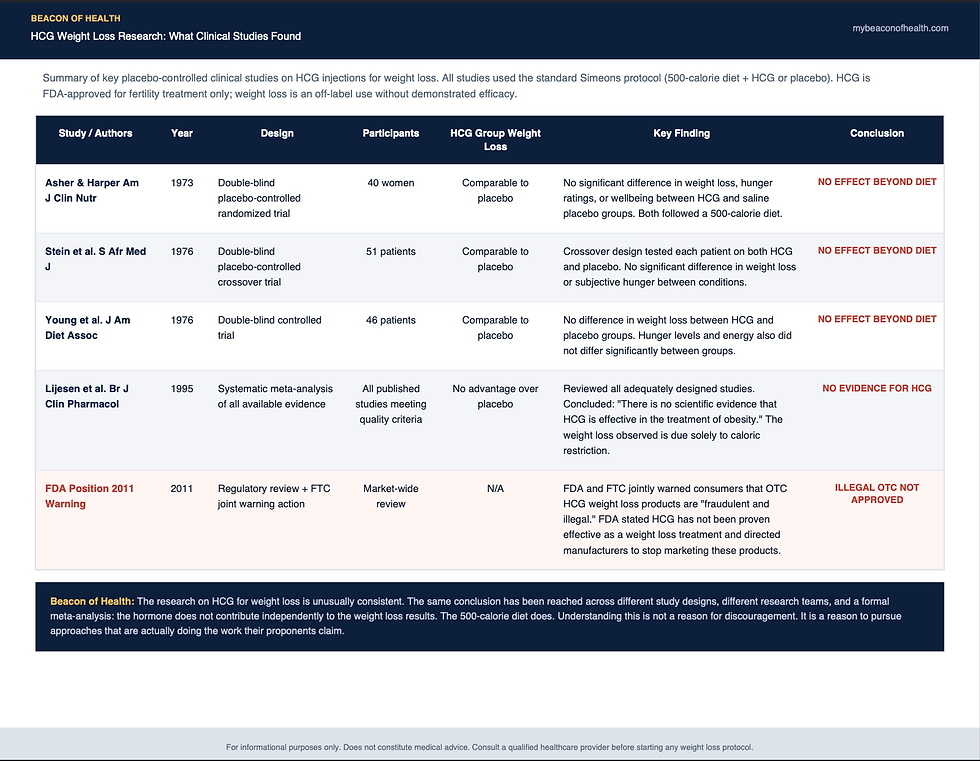
WHAT "DOUBLE-BLIND PLACEBO-CONTROLLED" MEANS FOR THIS CONVERSATION In a double-blind study, neither the patients nor the researchers administering treatment know who is receiving the real substance and who is receiving the placebo. This design eliminates the expectation effects that can make people feel or behave differently simply because they believe they are receiving an active treatment. When HCG studies used this design, the weight loss results between the two groups were the same. That is the strongest possible evidence that HCG specifically was not responsible for the outcomes.
Why People Do Lose Weight on the HCG Protocol
The weight loss people experience on the HCG protocol is real, and understanding why it happens is important both for accurately interpreting the results and for understanding why those results typically do not last.
The HCG diet requires consuming approximately 500 calories per day, divided into two small meals containing only specific proteins, vegetables, and limited fruits, with no fats, oils, or starches permitted. Five hundred calories per day represents an extreme deficit relative to almost any adult's maintenance calorie needs. The average adult requires between 1,600 and 2,400 calories per day to maintain body weight. A 500-calorie intake creates a deficit of 1,100 to 1,900 calories every single day. At that deficit level, significant scale movement is mathematically inevitable regardless of what else is happening.
The typical HCG protocol also produces the same pattern seen in any very low-calorie diet: rapid initial water and glycogen loss in the first days, followed by a combination of fat and muscle loss as the severe restriction continues, followed by metabolic slowdown as the body adapts to protect itself from starvation. The weight loss is real. The mechanism is the calorie restriction. The hormone is a passenger, not the driver.
The question about HCG injections for weight loss is not whether they are associated with results. They are, for the same reason that any 500-calorie-per-day diet is associated with results. The question is whether the hormone is adding anything to those results beyond what the diet alone produces. The research answer, consistently, is no.
Breaking Down the HCG Protocol: What Each Component Actually Does
The original Simeons protocol and its modern variations combine several elements, and separating what each one contributes helps clarify the picture for anyone evaluating whether this approach makes sense for them.

The table above makes a pattern visible that the marketing around HCG typically obscures: the element with the strongest evidence for producing the weight loss results is the 500-calorie diet. The element being marketed as the active ingredient, the HCG hormone, is the one with no evidence of independent effect. And the element most responsible for the results not lasting is the extreme calorie restriction itself, which produces the metabolic adaptation and muscle loss that make weight regain highly likely once normal eating resumes.
What the FDA Says and Why It Matters
The FDA has been unambiguous about HCG as a weight loss product. In 2011, the agency issued a joint warning with the Federal Trade Commission directing manufacturers to stop selling and marketing over-the-counter HCG weight loss products, which were being sold as homeopathic drops, pellets, sprays, and tablets.
The FDA's position is that HCG has not been demonstrated to be effective for weight loss, that the labeling and marketing of these products is misleading, and that the 500-calorie diet accompanying them poses health risks that consumers may not be adequately warned about. It is worth being clear about what this means and what it does not mean. HCG itself remains a legitimate, FDA-approved pharmaceutical when prescribed by a physician for its approved indications, primarily fertility treatment. The concern the FDA raised is specifically about HCG being marketed and sold for weight loss, which is an off-label use without an established evidence base for effectiveness, and about over-the-counter products that often contained negligible amounts of the hormone alongside misleading claims.
A physician prescribing HCG for weight loss is operating outside the approved indications for the drug in a context where the evidence for its specific contribution is, at best, absent. That is a different situation from using an evidence-based medication in an approved clinical context, which is what GLP-1 receptor agonists represent in current medical weight loss practice.
THE RISKS OF A 500-CALORIE DIET Regardless of what supplements or hormones accompany it, a 500-calorie-per-day diet carries meaningful medical risks that deserve direct acknowledgment. These include: significant loss of lean muscle mass, which reduces resting metabolic rate and makes future weight loss harder; gallstone formation, which increases with rapid weight loss; nutritional deficiencies that may cause fatigue, hair loss, electrolyte imbalances, and cardiac irregularities in extreme cases; and rebound weight gain when normal eating resumes, partly because the reduced muscle mass and lower metabolic rate make the body more efficient at storing calories than before the diet began. Anyone considering very low-calorie protocols should do so under direct medical supervision with appropriate monitoring.
What Produces the Same Scale Movement More Safely
The people searching for HCG weight loss results are looking for meaningful, relatively fast weight loss. That is a reasonable goal, and acknowledging it directly matters more than dismissing the interest in dramatic results. The question is how to achieve those results in a way that does not compromise muscle mass, metabolic health, or long-term prospects for keeping the weight off.
The most significant development in medical weight loss over the past several years has been the emergence of GLP-1 receptor agonist medications, including semaglutide and tirzepatide, which produce meaningful and clinically validated weight loss results through mechanisms that are genuinely pharmacologically active. Unlike HCG, these medications have passed rigorous placebo-controlled trials demonstrating that the drug itself, not the accompanying calorie deficit alone, is producing the effect. Clinical trials for semaglutide showed average weight loss of approximately 15 percent of body weight over 68 weeks in people without diabetes. Tirzepatide trials showed even larger effects, with some participants losing over 20 percent of body weight.
These are large, well-designed studies with reproducible results across diverse patient populations. They represent the evidence standard that HCG research failed to meet in the 1970s and has not met since. For people who have significant weight to lose and have not found lasting results through diet and exercise alone, these medications used under medical supervision represent a meaningfully different category of intervention from unproven hormone protocols.
The role of understanding your metabolic picture first
Before any weight loss intervention makes sense, understanding the specific metabolic factors at play for an individual person matters more than it is usually given credit for. Insulin resistance, thyroid function, hormonal balance, medication effects, and sleep quality all affect how the body responds to calorie restriction and what approaches are likely to work. Someone with unrecognized insulin resistance, for example, may find that extreme calorie restriction produces fast initial results followed by rapid regain regardless of the hormone or supplement accompanying the protocol, because the underlying metabolic driver has not been addressed.
A clinical evaluation that includes appropriate labs and a thorough history before committing to any weight loss approach is not a delay. It is the information that makes the approach actually fit the person rather than fitting a generic template that happens to work for some people and not for others.
IF YOU HAVE ALREADY TRIED HCG If you have already completed an HCG protocol and lost weight that subsequently returned, that experience is consistent with what the research predicts. It is not a reflection of your effort or discipline. The metabolic effects of a very low-calorie diet, particularly muscle loss and metabolic rate reduction, create conditions that make weight regain statistically likely once normal eating resumes. That experience does not mean durable weight loss is impossible. It means the approach did not address the underlying metabolic conditions. A medical weight loss evaluation can help identify what those conditions are and what would actually address them.
FROM THE BEACON OF HEALTH TEAM The Beacon clinical team sees patients regularly who have tried HCG protocols along with a range of other approaches before seeking medical guidance. The team does not judge those attempts. The people who pursue them are motivated and deserve honest information, which most HCG marketing does not provide. What the clinical team consistently finds is that the patients who struggled with HCG results not lasting have a metabolic picture that was never fully assessed. Once that picture is understood, the right tools become clearer. Those tools now include evidence-based medications with genuinely strong clinical trial data behind them, used within a comprehensive approach that addresses the whole person rather than just the calorie math. That is the difference between what Beacon offers and what an unmonitored protocol provides.
If you are looking for meaningful weight loss results backed by clinical evidence and supported by a licensed provider, Beacon of Health provides virtual medical weight loss care built around your individual metabolic picture. No unproven protocols. No extreme restriction without medical oversight. Just evidence-based care that addresses what is actually happening in your body.


Comments